
How Agile Factories Unlock Speed, Customization, and National Resilience
Why the Future of Manufacturing Looks More Like Software Than a Factory Floor
Manufacturing has always been the slow, stubborn middle step between a good idea and a real product. You can design something brilliant in an afternoon, but building it, tooling it, validating it, and scaling it up can take years. That gap between imagination and reality is exactly what Edward Mehr, co-founder and CEO of Machina Labs, is trying to close.
In Episode 122 of Machine Minds hosted by Greg Toroosian, the CEO and Founder of Samson Rose, he sat down with Edward to talk about what happens when you stop treating factories as fixed, single-purpose machines and start treating them as flexible, software-driven systems that can build almost anything. It is a conversation that touches on aerospace, automotive, national security, and even the idea of manufacturing on the Moon. If you care about where physical products are headed, this episode is worth your full attention, and this blog will walk you through the key ideas so you can decide where to dig in deeper.
From Software Obsession to SpaceX to Metal Forming
Edward’s path to founding Machina Labs did not start in a machine shop. It started with an early fascination with computers and a genuine love of making things with his hands. That mix of digital and physical thinking followed him through his career, including a stint at SpaceX, where he learned a lesson that shapes everything he does today.
At SpaceX, Edward saw firsthand that the real bottleneck in hardware companies is rarely engineering ambition. Teams can design incredible things. The constraint is almost always manufacturing speed. You can have the best design in the world, but if it takes eighteen months to tool a part, your ambition does not matter much. That realization became the founding insight behind Machine Labs.
The Problem With Traditional Factories
Here is the core issue Edward and Greg dig into on the episode: traditional factories are built around a single design. A stamping press, a mold, or a die is expensive and time-consuming to produce, and once it exists, it is locked into making one specific part. Change the design, and you often need a whole new tool.
This creates a chain of problems that ripple through entire industries:
Long lead times between designing a part and actually producing it.
High upfront tooling costs that make small production runs impractical.
Factories that are essentially frozen in place, unable to pivot when designs change.
A structural disadvantage for companies trying to iterate quickly or customize products.
Machina Labs is built around a simple but ambitious idea. What if the factory itself did not need to change every time the product did? What if the factory was the real product, and the parts coming out of it were just one expression of what it could build?
Meet the Robocraftsman
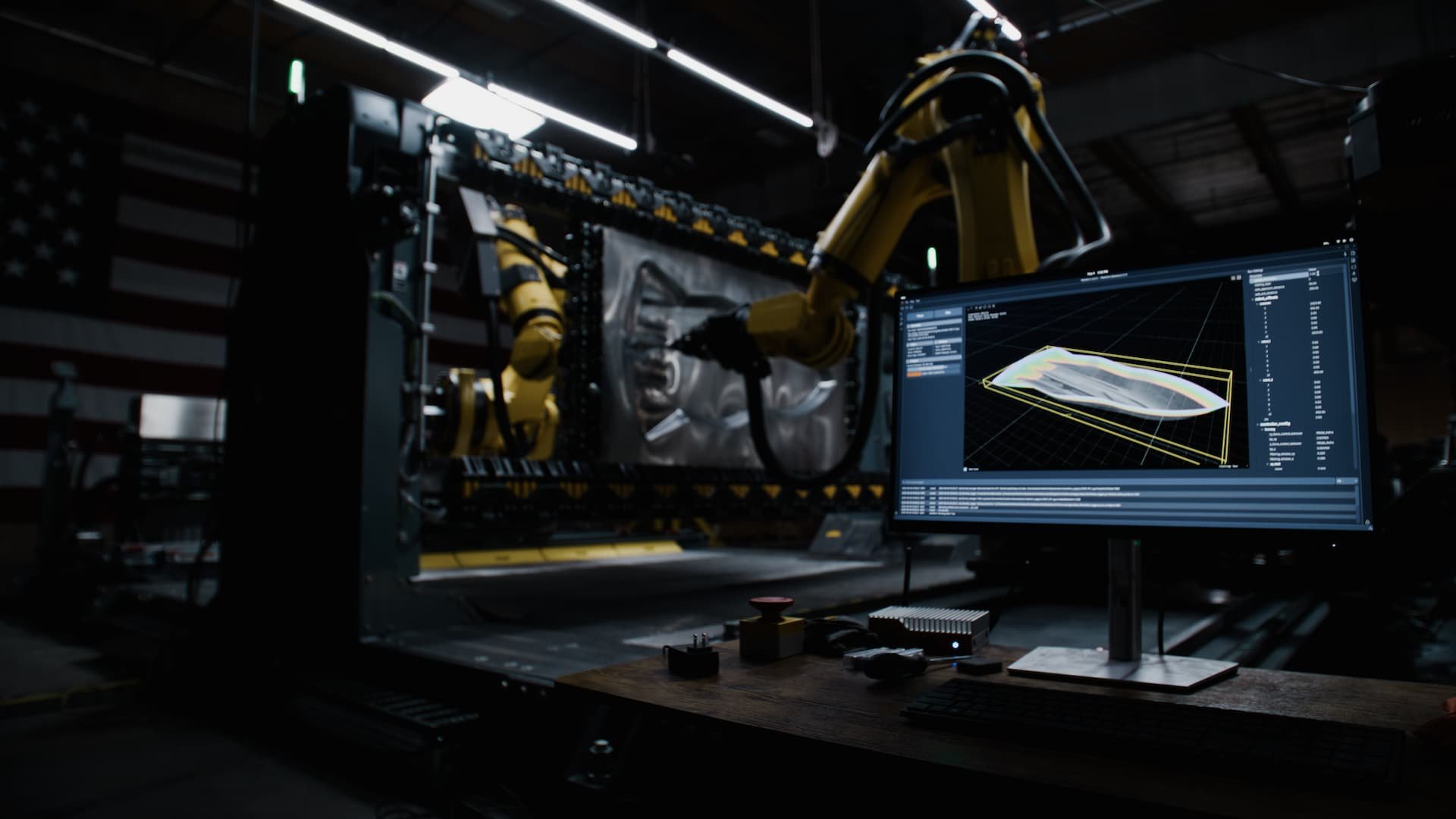
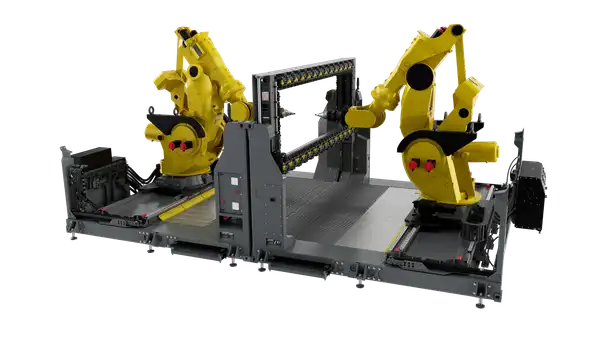
The centerpiece of the conversation is what Machina Labs calls the Robocraftsman. It is a robotic system that forms metal without molds or dies, combining physical dexterity with AI-driven learning. Rather than being locked into a single shape, the Robocraftsman adapts its process in real time, learning the way a skilled human craftsperson would over years of practice, except it can apply that learning immediately across a huge range of parts.
Edward explains that this system pulls data from two places at once. It learns from the physical act of forming metal, and it learns from simulation, using both to continuously refine how it applies force, selects tooling, and manages process parameters. The result is a system that gets smarter the more it works, and that can shift from one part design to another without the months of retooling a traditional factory would require.
This is where the software analogy really clicks. A software team can push an update and change how an application behaves overnight. Machina Labs is trying to bring that same speed and flexibility to physical manufacturing, so that changing a part design becomes closer to changing a line of code than commissioning a new tool.
Real World Impact: Aerospace, Defense, and Automotive
It is one thing to build an impressive system, but it is another to prove it works where it counts. On the episode, Edward walks through some of the early traction Machina Labs has seen in industries that cannot afford to move slowly.
A few highlights worth calling out:
Aerospace and Defense: Machina Labs has dramatically cut lead times for legacy aircraft parts, some of which previously took years to replace. In an industry where planes can stay in service for decades, being able to produce a hard-to-find part quickly is a genuine breakthrough.
Automotive Manufacturing: The company is expanding into automotive, enabling manufacturers to pursue mass customization directly, without the expensive tooling investment that has traditionally made small batch or customized production impractical.
A Major Partnership in the UAE: Machina Labs has entered into a significant partnership focused on rapidly deployable, distributed manufacturing for both defense and commercial resilience, a signal of how seriously governments and industry are taking the need for flexible production capacity.
That last point connects to one of the more thought-provoking parts of the conversation. Greg and Edward talk about factories not just as business assets, but as national security assets. In a world where global supply chains have proven fragile again and again, the ability to stand up manufacturing capacity quickly, close to where it is needed, is becoming a strategic priority rather than just an operational nice-to-have.
Portable Factories and the Path to Off-World Manufacturing
One of the more ambitious topics in the episode is the idea of portable, containerized manufacturing systems. If a factory does not need to be a massive permanent structure built around a single product, it can be smaller, more modular, and more mobile. That opens the door to deploying manufacturing capability exactly where it is needed, whether that is a remote defense installation or a disaster response zone.
Edward takes that idea even further, connecting it to the long-term vision of manufacturing beyond Earth. If factories can be compact, adaptable, and less dependent on fixed infrastructure, the same principles that make Machina Labs useful here could eventually support production on the Moon or Mars. It sounds like science fiction, but the underlying logic follows directly from the core thesis of the company: manufacturing capability should travel with need, not the other way around.
Building the Team Behind the Technology
Technology this ambitious does not build itself, and Edward is candid about the organizational challenge of running a company that sits at the intersection of robotics, AI, and materials science. These three are the deep, technical disciplines that do not always speak the same language, and getting engineers from each of them to collaborate effectively takes real infection.
Edward also shares how his own approach to leadership has evolved as Machina Labs has grown. Early on, a founder can be close to every decision, but as the company scales, that becomes impossible, and the job shifts toward building systems and teams that can make good decisions without the founder in the room. It is a challenge familiar to anyone who has scaled a hard tech company, and Edward’s perspective offers a grounded, practical view of what that transition actually looks like.
Why This Conversation Matters
What makes this episode of Machine Minds stand out is that it is not just a story about a clever robot. It is a story about rethinking what a factory even is. Edward Mehr’s central argument- that the factory itself should be the product- is a genuinely different way of framing the manufacturing problem, and it has implications that stretch from your car to national defense to the long-term future of human presence beyond Earth.
For founders, engineers, and investors working anywhere near robotics or advanced manufacturing, there is a lot to take from this conversation about where the industry is heading and what kind of thinking is required to get there.
This is exactly the kind of forward-looking conversation that Greg Toroosian and Samson Rose bring to the robotics and hard tech community every week through Machine Minds. Samson Rose is a boutique retained search firm built specifically for robotics, hard tech, and AI companies, and Greg’s deep relationships across the industry are part of what makes these conversations so candid and substantive. If your company is building something ambitious in this space and you are trying to find the right people to help you get there, Samson Rose is worth a try.
Deepen Your Understanding of Software-Defined Manufacturing
Explore More from Machine Minds and Machina Labs:
Listen to the Full Discussion: Head over to Spotify or Apple Podcasts for How Agile Factories Unlock Speed, Customization, and National Resilience with Edward Mehr.
Analyze the Technical Architecture: Visit the official Machina Labs platform to explore their Robocraftsman technology, resources, and case studies.
Connect with the Guest: To follow insights on advanced manufacturing, robotics, and AI-driven production, look up Edward Mehr on LinkedIn.