
How to Hire Reinforcement Learning Engineers
Key Takeaways
Define the problem first: Hire a reinforcement learning engineer when your company needs systems that can optimize sequential decisions, adapt to changing environments, or improve autonomous behavior.
Prioritize RL fundamentals: Look for knowledge of reinforcement learning algorithms, reward functions, policies, value functions, exploration, and model evaluation.
Look beyond algorithms: Strong candidates should also have practical programming, machine learning, software engineering, simulation, and deployment skills.
Evaluate real-world experience: Ask candidates to explain projects they have built, including their approach to reward design, experimentation, failures, performance metrics, and deployment.
Match skills to your application: Robotics companies may need experience with simulation, C++, computer vision, control systems, and sim-to-real workflows, while other applications may require different technical expertise.
Keep the hiring process focused: Define must-have qualifications, use practical technical assessments, and avoid unnecessary interview stages that can cause specialized candidates to drop out.
Consider specialized recruiting support: Companies hiring for difficult-to-fill robotics, AI, and hard-tech roles can benefit from a recruiting partner with access to specialized technical talent.
Reinforcement learning engineers build systems that learn through interaction, rewards, and feedback. Hire for strong RL fundamentals, programming, and production skills.
Hiring a reinforcement learning engineer is different from hiring a general machine learning engineer. Candidates need deep algorithmic knowledge and the ability to turn experiments into reliable systems. In robotics and advanced technology, that distinction matters because a promising model must perform consistently in the real world.
Related Article: How to Hire a Machine Learning Engineers in 2026
What Is a Reinforcement Learning Engineer?
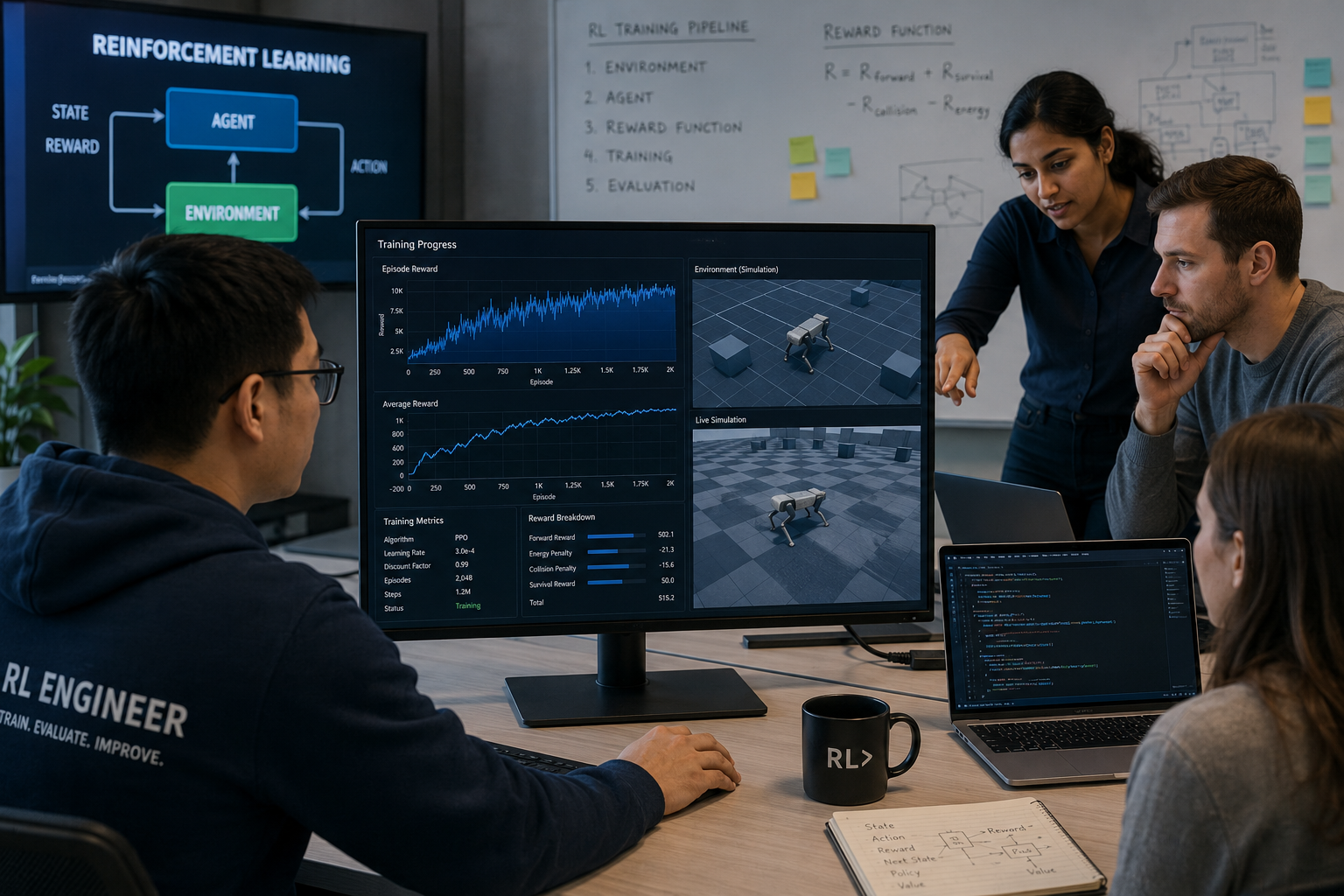
A reinforcement learning (RL) engineer develops machine learning systems that learn how to make decisions through interaction with an environment. Instead of training only from labeled examples, an RL system receives feedback through rewards and uses that experience to improve its policy over time.
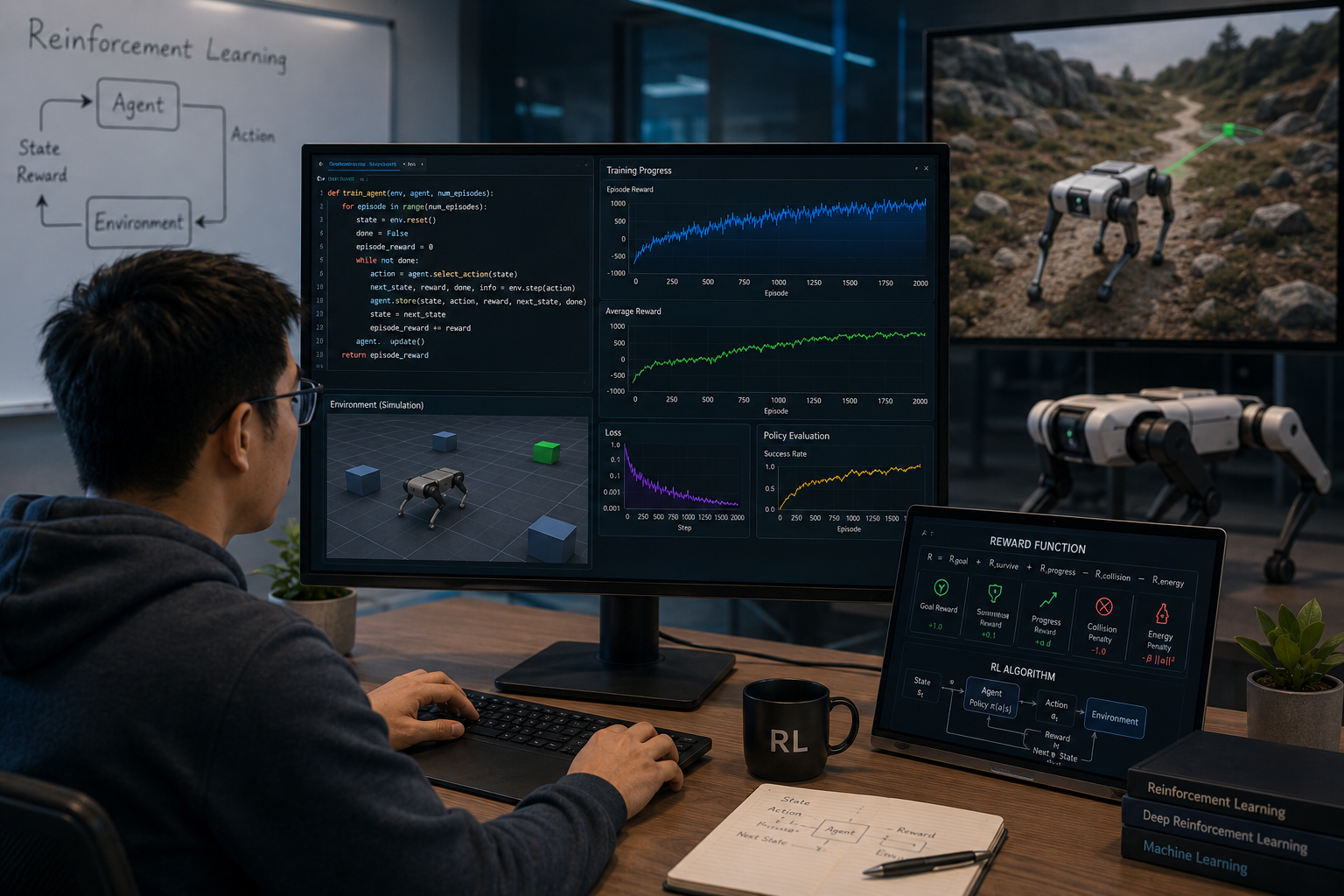
The engineer works with the RL loop: an agent observes a state, selects an action, receives feedback, and updates its behavior. Work can include environment design, reward definition, algorithm selection, experimentation, and generalization testing.
What Does a Reinforcement Learning Engineer Do?
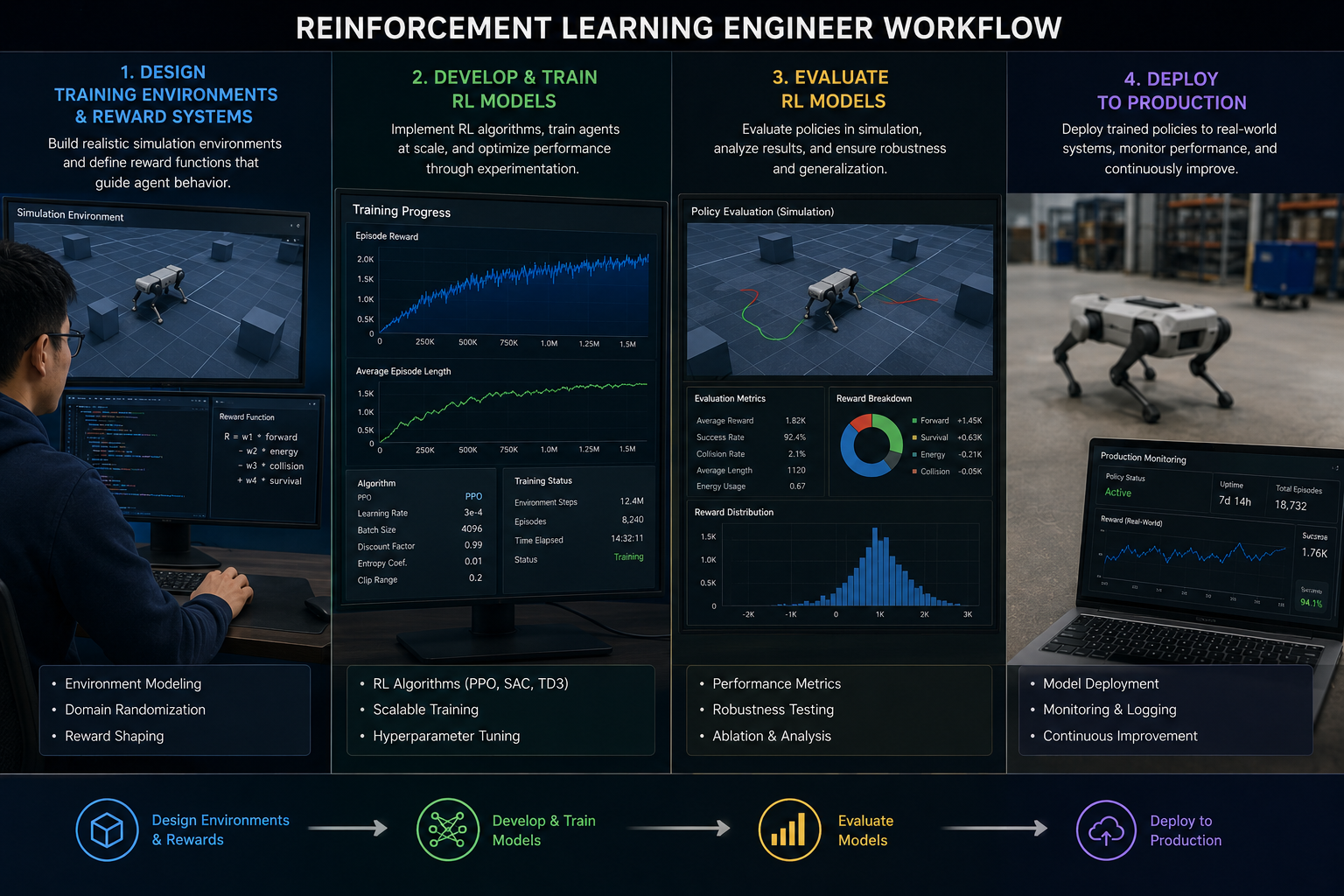
Design environments and rewards
A candidate may build or adapt simulated environments and define the observations, actions, constraints, objectives, and reward signals used during training. This is critical: a poorly designed reward can encourage behavior that technically maximizes the score while failing the actual business objective.
Develop and train RL models
Engineers select and implement appropriate approaches, such as value-based methods, policy-gradient methods, actor-critic algorithms, model-based RL, or imitation learning. They run controlled experiments and adjust training strategies based on evidence rather than simply trying algorithms at random.
Evaluate performance
Good RL work goes beyond reporting training rewards. Engineers should test stability, generalization, failure modes, sample efficiency, and performance under changed conditions. Physical systems may require safety testing.
Productionize the system
In commercial environments, an RL engineer may build training pipelines, optimize GPU workloads, integrate models with existing software, and move policies from simulation into production. Current RL roles frequently combine RL expertise with Python, deep-learning frameworks, distributed training, and software engineering.
Related Article: What Is a Software Engineer & Why Do We Need One?
When Should Your Company Hire a Reinforcement Learning Engineer?
Hiring makes sense when reinforcement learning is solving a defined business or engineering problem, not simply because RL is fashionable.
When the problem involves sequential decisions
RL can be appropriate when actions affect future states and the system must optimize behavior over time. Examples include robot motion, autonomous navigation, resource allocation, scheduling, recommendation strategies, and complex control problems.
When conventional approaches have reached a ceiling
If rules, supervised learning, or traditional optimization cannot adequately handle changing environments or long-term decision-making, specialized RL expertise may be justified.
When you are moving from research to deployment
A common trigger is the gap between an impressive research prototype and production. An engineer who understands RL theory and deployment can establish repeatable experiments and reliable training infrastructure.
When robotics is becoming more autonomous
Robotics companies often need engineers who can connect perception, simulation, planning, control, and learned policies. Current robotics-focused RL roles commonly ask for experience with simulation environments, deep-learning frameworks, Python, C++, and real-world robotic systems.
Skills and Qualifications to Look for in a Reinforcement Learning Engineer
The best profile depends on seniority and application, but several capabilities consistently matter.
Core reinforcement learning knowledge
Look for understanding of Markov decision processes, states, actions, policies, rewards, value functions, exploration, policy evaluation, and training stability. Candidates should explain why an algorithm fits a problem.
Programming and machine learning
Python is commonly essential. Experience with PyTorch, JAX, or TensorFlow is valuable, while C++ can matter for robotics, embedded systems, and performance-sensitive applications. Familiarity with Gymnasium, RLlib, Stable-Baselines, or comparable frameworks is useful depending on your stack.
Simulation and robotics experience
For embodied AI, prioritize candidates who have worked with simulators, robot environments, physics engines, sensor data, or sim-to-real workflows. MuJoCo or Isaac-style experience can be useful when simulation is central to the product.
Related Article: Moxie by Embodied: Redefining Learning Companionship Through AI and Robotics
Research and experimentation
Strong candidates should form hypotheses, design experiments, interpret results, debug training, and document what changed. Practical project evidence can be more revealing than publications alone.
Production engineering
Do not overlook software engineering. Training infrastructure, testing, distributed computing, monitoring, and deployment often determine whether an RL project becomes a product.
How to Evaluate Reinforcement Learning Engineer Candidates
Start with the candidate's projects
Ask the candidate to explain one RL system from problem definition through deployment: the environment, reward design, algorithm choice, failures, and performance metrics. Ask what happened when training became unstable or reward increased without improving the real objective.
Use a practical technical assessment
A short, realistic exercise can ask candidates to design an RL approach for a robot navigation or resource-allocation problem. Evaluate their assumptions, reward design, metrics, experiment plan, and ability to identify risks. The goal is not to test how quickly they can reproduce a tutorial.
Assess communication and collaboration
RL projects often sit between research, software, hardware, product, and operations. Candidates should be able to explain technical uncertainty to non-specialists and work productively with people who do not share their exact discipline.
Best Practices for Hiring Reinforcement Learning Engineers
Define the problem before defining the title
Start with the business or technical outcome. Then determine whether you need a research engineer, applied RL engineer, robotics learning engineer, or broader ML engineer. This prevents vague requirements.
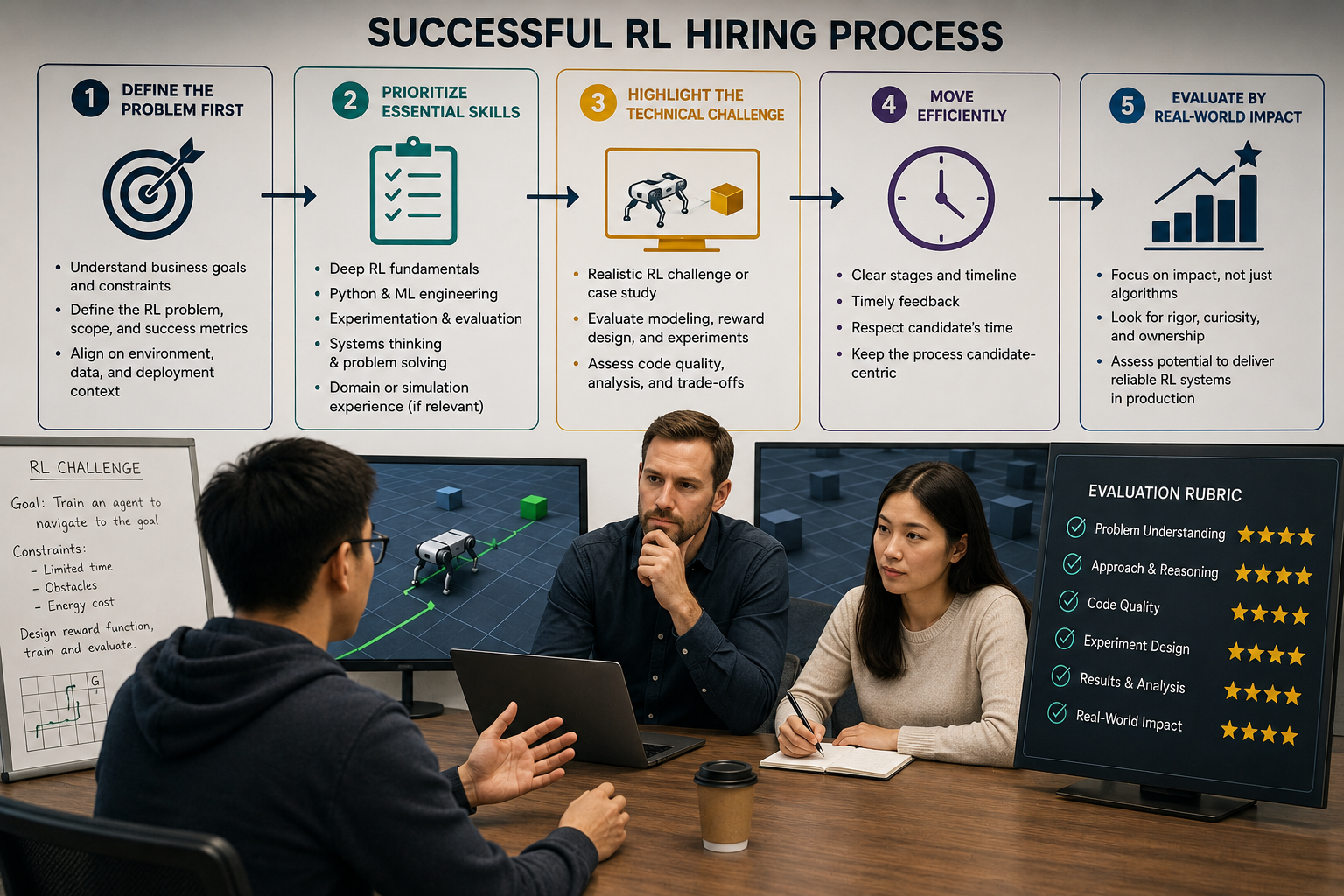
Separate must-have skills from learnable skills
Do not turn every technology your team uses into a mandatory requirement. For example, deep RL experience may be essential, while a particular simulator can often be learned. Focus the requirements on capabilities that are genuinely difficult to acquire quickly.
Sell the technical challenge
Experienced RL engineers are often motivated by difficult problems, autonomy, strong peers, and meaningful ownership. Explain what they will build, why it matters, and how success will be measured.
Move quickly without lowering the bar
Specialized candidates have options. Keep interviews rigorous but efficient, with clear decision criteria and limited unnecessary stages.
Look for evidence of real-world impact
A candidate who has improved a system, shipped a model, reduced training cost, increased robustness, or solved a difficult deployment problem can be more valuable than someone whose experience is limited to theoretical exercises. Ask for measurable outcomes wherever possible.
Build a Strong Reinforcement Learning Team With the Right Hiring Strategy
Knowing how to hire reinforcement learning engineers starts with understanding the problem your company is trying to solve and then defining the combination of RL expertise, software engineering, and domain knowledge required to solve it. The right hire should be able to reason about algorithms, experiment methodically, communicate tradeoffs, and turn research into dependable technology.
For robotics, artificial intelligence, and advanced-technology companies, specialized recruiting knowledge can make a meaningful difference. Samson Rose focuses on talent search for robotics, AI, and hard tech, helping organizations identify senior leaders, directors, C-suite executives, and highly specialized technical professionals. Its retained search approach is built around understanding the company's technology, team, and long-term hiring needs rather than treating a technical role like a generic vacancy.
If you need help finding specialized RL, AI, robotics, or hard-tech talent, contact Samson Rose to discuss your hiring needs.
Frequently Asked Questions
-
There is no fixed timeline. A specialized search can take several weeks to a few months depending on seniority, location, compensation, technical requirements, and the availability of candidates with relevant experience. Highly specialized robotics or research roles generally require a deeper search.
-
Robotics and autonomous systems are major applications, but RL engineers can also contribute to logistics, manufacturing, healthcare, finance, gaming, recommendations, and other sequential decision problems.
-
Python is usually the most important language, alongside frameworks such as PyTorch, JAX, or TensorFlow. Depending on the role, employers may also value C++, GPU programming, simulation environments, distributed computing, and RL libraries such as Gymnasium or RLlib.
-
Internal hiring can work well when you already have a technical recruiting function and strong talent network. A specialized firm can help when the candidate pool is small or passive talent is difficult to reach.
-
Include the business problem, responsibilities, required RL knowledge, programming languages, ML frameworks, domain experience, seniority, location, compensation where appropriate, and expected outcomes. Clearly distinguish essential qualifications from preferred skills so qualified candidates can assess the opportunity quickly.