
The Robot That Can Do Anything: Inside Boston Dynamics’ Vision for Atlas
A Milestone Episode Asks a Big Question
For the 150th episode of Machine Minds, host Greg Toroosian, CEO of Samson Rose, sat down with Brian Ringley, Human-Robot Interaction Designer at Boston Dynamics, to dig into a question that gets at the heart of where robotics is headed. What happens when a robot is no longer built for one fixed task, but can be retasked through software to do thousands of different things instead?
That question runs through the entire conversation, and it is a good lens for understanding why Boston Dynamics builds robots the way it does, from Spot all the way up to Atlas.
An Unconventional Path Into Robotics
Brian’s own background is part of what makes this episode so interesting. He did not come up through a traditional robotics track. His path started in architecture, then moved through CNC machining, industrial robotic arms, computational design, and construction technology before he found himself working at the intersection of digital models and physical automation.
That journey eventually led him to Boston Dynamics, where his role has shifted several times:
He first explored construction applications for Spot;
He then moved into product management and industrial inspection;
Now, he works on human-robot interaction design for Atlas.
It is a career shaped by curiosity and cross-disciplinary thinking, and Greg made a point of drawing out how that unusual mix of experience shaped Brian’s approach to human-machine collaboration today.
Why Construction Became Spot’s Early Proving Ground
Before Atlas became the headline story, Spot had to prove itself somewhere, and construction turned out to be an ideal testing ground. Brian walked through how Spot found real traction on job sites, including:
Reality capture and laser scanning for tracking site conditions;
Safety monitoring across active construction environments;
Project progress tracking that helped teams catch problems earlier.
These use cases matter because they reveal something important about how Boston Dynamics thinks about value. It is not just about the robot itself; it is about what the robot enables.
The Shift From “Robot as Product” to “Robot as Invisible Layer”
One of the most important ideas in the episode is a mental shift Brian described. Early on, it is tempting to think of a robot as the product itself, the thing customers are buying and getting excited about. But Brian argues the more useful framing treats the robot as an invisible physical layer, one that creates value through the work it quietly enables rather than through the robot as a spectacle.
That distinction has real consequences. It pushes a company to focus less on flashy demonstrations and more on reliability, integration, and the everyday tasks a robot actually needs to handle to earn its place in a workflow.
Why Collecting Data Alone Is Not Enough
Robots like Spot generate enormous amounts of data as they move through job sites and facilities. Brian was clear that simply collecting more of it is not the answer. The real opportunity lies in how that data gets turned into something people can actually use.
He pointed to vision-language models and generative interfaces as a path toward letting operators effectively have a conversation with a factory or a construction site, asking questions in plain language and getting useful answers back instead of digging through raw sensor logs themselves.
The Enormous HRI Challenge Behind Atlas
Designing the interaction model for Atlas is a different kind of problem entirely, and it sits at the center of Brian’s current work. Atlas is not built for one task. Its potential capabilities are effectively unbounded, which means the interface between human and robot has to be flexible enough to keep up.
Brian described how several different technical approaches work together across the Atlas autonomy stack, including:
Reinforcement Learning;
Behavior Cloning;
Vision-language-action Models;
Reasoning Systems;
Traditional software tools, still doing plenty of heavy lifting.
No single approach solves the whole problem. It takes all of them working together.
The Real Promise of Humanoids, According to Brian
Here is where the conversation gets genuinely interesting. Brian sees the real promise of humanoid robots less as a technology story and more as an economic one. Instead of needing a new purpose-built machine for every application, a single hardware platform can be retasked through a software.
That is a meaningful shift in how physical automation gets built and scaled. But Brian was quick to point out that general-purpose hardware also demands generalizable software interfaces. You cannot simply build a brand-new application from scratch every single time the robot learns a new task. The interface layer has to scale right alongside the hardware.
Balancing Human-Like Movement With Industrial Purpose
Greg and Brian also spent time on a design tension that is easy to overlook. Boston Dynamics has to balance natural, human-like movement in Atlas with a superhuman range of motion, all while deliberately treating the robot as an industrial tool rather than an attempt to imitate a person.
That is a subtle but important distinction. Atlas does not need to move like a human just to look familiar. It needs to move in whatever way gets the job done safely and efficiently, even when that means moving in ways a person physically could not.
Great Hardware Still Matters in the Age of Physical AI
With so much attention on software and AI models right now, it is easy to assume hardware has become secondary. Brian pushed back on that idea directly. Great hardware still matters enormously, and he highlighted several reasons why:
Reliability in real-world conditions, not just in a lab;
Field serviceability, since robots deployed at scale need to be fixable on-site;
Strength-to-weight ratios that determine what a robot can actually do;
Range of motion that expands the set of tasks within reach;
Manufacturability, because a robot that cannot be built at scale cannot be deployed at scale;
Uptime, which is ultimately what customers are paying for.
What the Google DeepMind Partnership Brings to the Table
The conversation also touched on Boston Dynamics’ partnership with Google DeepMind, and why pairing frontier reasoning models with high-quality robotic hardware can accelerate both sides of the equation. Better reasoning models make the hardware more capable, and better hardware gives those models something meaningful to act through in the physical world.
A Vision for the Software-Defined Factory
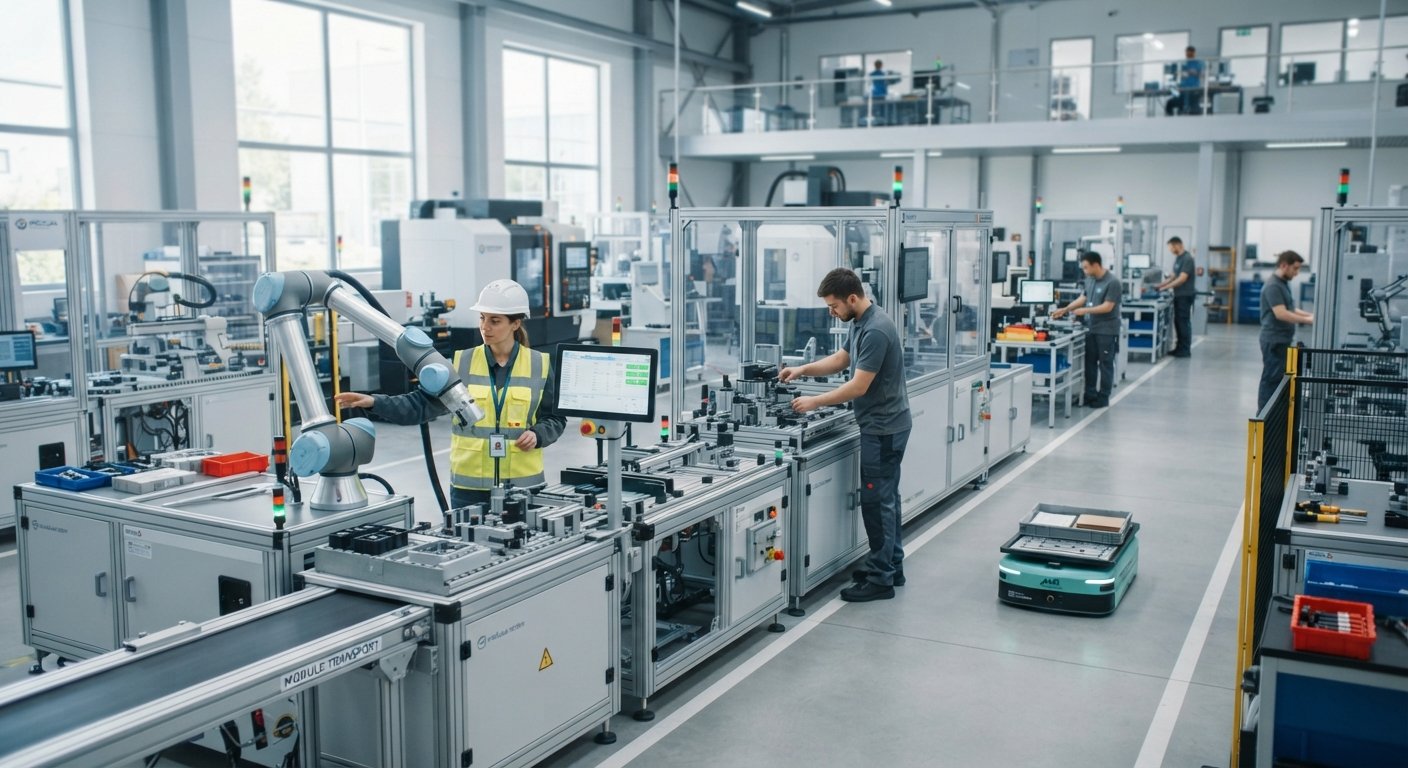
Brian shared a picture of where things are headed that is worth sitting with. He described a software-defined factory where humanoids work alongside AMRs, fixed automation, inspection robots, digital twins, and other specialized machines, rather than replacing them outright.
This is a grounded vision. Humanoids are not positioned as a silver bullet that makes every other form of automation obsolete. They are one more tool in a broader, increasingly connected system.
Why Teleoperation Is Not Going Away
Even as autonomy keeps improving, Brian made the case that teleoperation will remain genuinely valuable, especially in environments that are unsafe for people. Think nuclear facilities, underground mines, collapsed buildings, and launch sites. In these settings, having a skilled human guide a robot remotely is not a stopgap. It is often the smartest and safest option available.
Overestimated Short-Term, Underestimated Long-Term
Brian closed with a reflection that anyone following robotics closely will recognize. The field consistently gets overestimated in the short-term and underestimated in the long-term. Building systems that can understand natural instructions, reason about unfamiliar situations, manipulate the physical world, and operate reliably at scale is extraordinarily difficult work. But that difficulty is also exactly what makes the field so compelling to people like Brian and Greg.
About Machine Minds and Samson Rose
This milestone 150th episode is part of Machine Minds, the podcast where Greg Toroosian talks with the founders, engineers, and operators shaping the future of robotics, AI, and hard tech. Greg brings a distinct perspective to these conversations as the founder of Samson Rose, a staffing and talent search firm built specifically for robotics and AI companies.
That perspective shows up clearly in this episode. Greg does not just ask about the technology. He draws out how Brian’s unconventional career path, moving from architecture through construction tech and into human-robot interaction design, shaped the way he thinks about building teams and products at the edge of what is possible.
If your company is building robotics, physical AI, or human-robot interaction and you are thinking about how to find people with exactly this kind of cross-disciplinary background, Samson Rose specializes in connecting hard tech companies with talent built for this moment.
Deepen Your Understanding of Human Robotics
Explore more from Machine Minds and Boston Dynamics:
Listen to the Full Discussion: Head over to Spotify or Apple Podcasts for Designing the Robot that Can Do Anything with Brian Ringley.
Analyze the Technical Architecture: Visit the official Boston Dynamics platform to explore Atlas, Spot, and the systems behind them.
Connect with the Speaker: To follow insights on human-robot interaction, construction robotics, and the future of humanoid design, look up Brian Ringley on LinkedIn.