

The Blog
From

Discover diverse topics, expert insights, and captivating narratives in our thought-provoking blog collection.
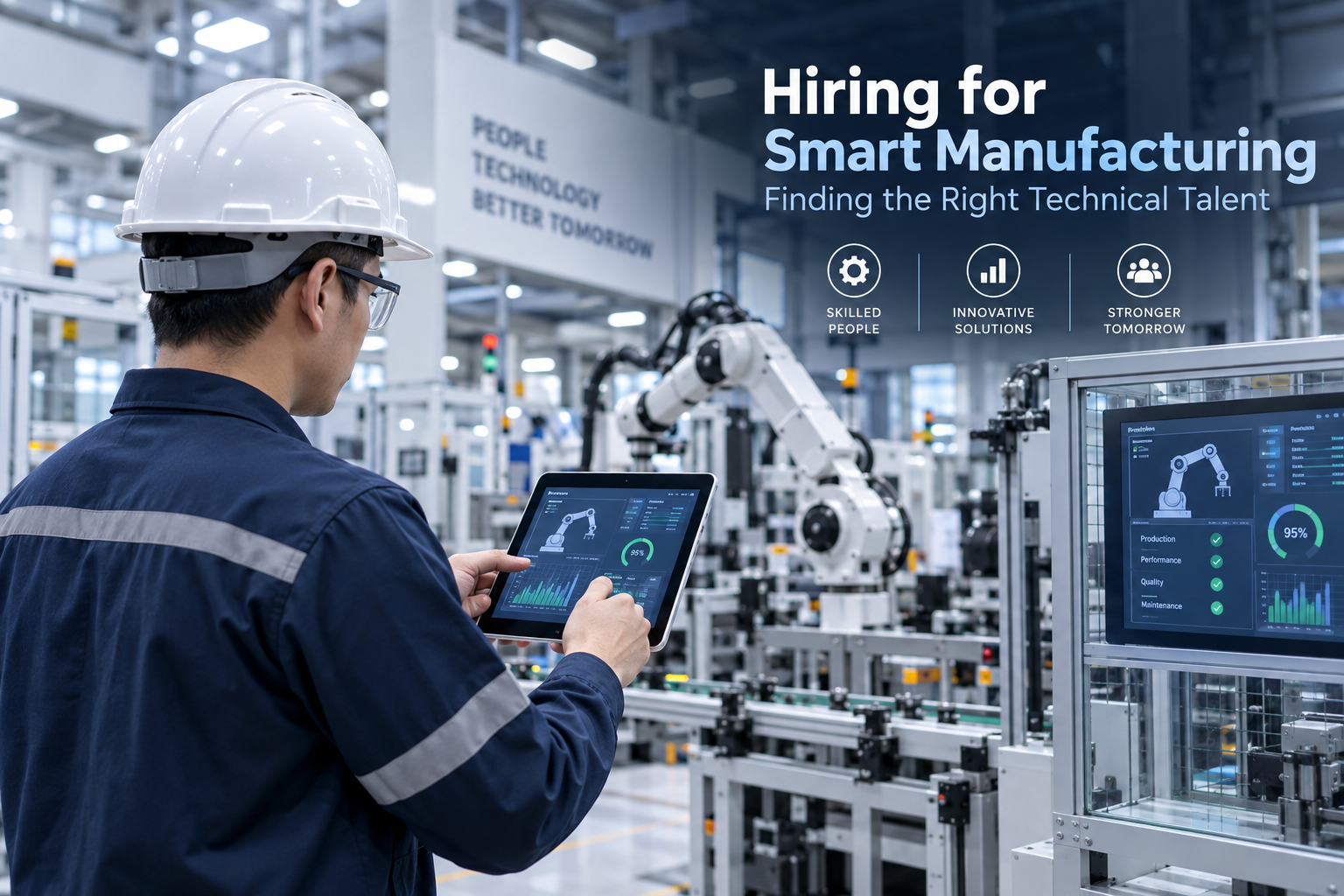
Hiring for Smart Manufacturing: Finding the Right Technical Talent
Manufacturing recruitment has changed dramatically over the past decade. Factories that once needed mechanically skilled operators now need engineers who can work fluently with robotics, sensors, and machine learning models running on the shop floor. That shift has made hiring for smart manufacturing one of the hardest challenges facing plant managers and HR leaders today. The people who can bridge traditional manufacturing know-how with software and data skills are scarce, and the competition for them stretches well beyond the manufacturing sector itself. Getting this hiring right isn't just about filling a role; it's about building the technical backbone that determines whether a smart factory initiative actually delivers on its promise. Companies that treat this hiring the same way they've always filled floor positions tend to fall behind competitors who've adapted their approach.

Retained vs Contingency Search: Which Is Right for Your Business?
Hiring the right recruiting partner can feel just as important as hiring the right candidate, and the retained vs contingency search decision is often where that choice starts. Both models get roles filled, but they operate on very different incentives, timelines, and levels of commitment from the recruiter. Picking the wrong one for a given role can mean a slower search, a weaker candidate pool, or a hire that doesn't stick around long enough to justify the cost of finding them. This guide breaks down how each model actually works, where they genuinely differ, and how to decide which one fits your next hire, whether that's a mid-level manager or a hard-to-find technical executive.

What Is Mechanical Engineering? A Complete Guide
Mechanical engineering is one of the broadest engineering disciplines, combining physics, mathematics, materials science, and practical design to solve problems involving machines and physical systems. Its work can range from developing a small medical device to designing propulsion systems, industrial equipment, robots, or energy infrastructure.
What makes the field distinctive is its focus on how things move, transfer energy, withstand forces, produce heat, and perform reliably in real conditions. Mechanical engineers often work throughout a product's lifecycle, from an early concept and computer-aided design to testing, manufacturing, maintenance, and improvement.
For companies building advanced technology, mechanical engineering can also overlap with electronics, software, controls, robotics, artificial intelligence, and automation. That interdisciplinary nature is one reason mechanical engineering remains relevant across many industries.

How to Hire Reinforcement Learning Engineers
Reinforcement learning engineers build systems that learn through interaction, rewards, and feedback. Hire for strong RL fundamentals, programming, and production skills.
Hiring a reinforcement learning engineer is different from hiring a general machine learning engineer. Candidates need deep algorithmic knowledge and the ability to turn experiments into reliable systems. In robotics and advanced technology, that distinction matters because a promising model must perform consistently in the real world.

Turning Robot Data Into Real Insight
Everyone talks about the robots. Fewer people talk about the data those robots leave behind, and that gap is exactly where things start to break down as robotics companies grow. A single robot can generate gigabytes of telemetry every minute, spread across video, sensor readings, and logs. Multiply that across a fleet, and most engineering teams end up drowning in information while somehow still starving for real insight.

What Is a Software Engineer & Why Do We Need One?
Software is now part of almost every business, from customer-facing apps and online stores to internal systems, automation tools, and AI platforms. Yet software does not become useful simply because someone can write code. It needs planning, architecture, testing, security, maintenance, and a clear understanding of the problem it is meant to solve.
That is where a software engineer comes in. They apply programming and engineering principles to create technology that is dependable, scalable, maintainable, and useful. The right engineer can also influence product decisions, reduce technical risk, and create a foundation for growth.