
Technical Recruiter vs. General Recruiter: What's the Difference?
Key Takeaways
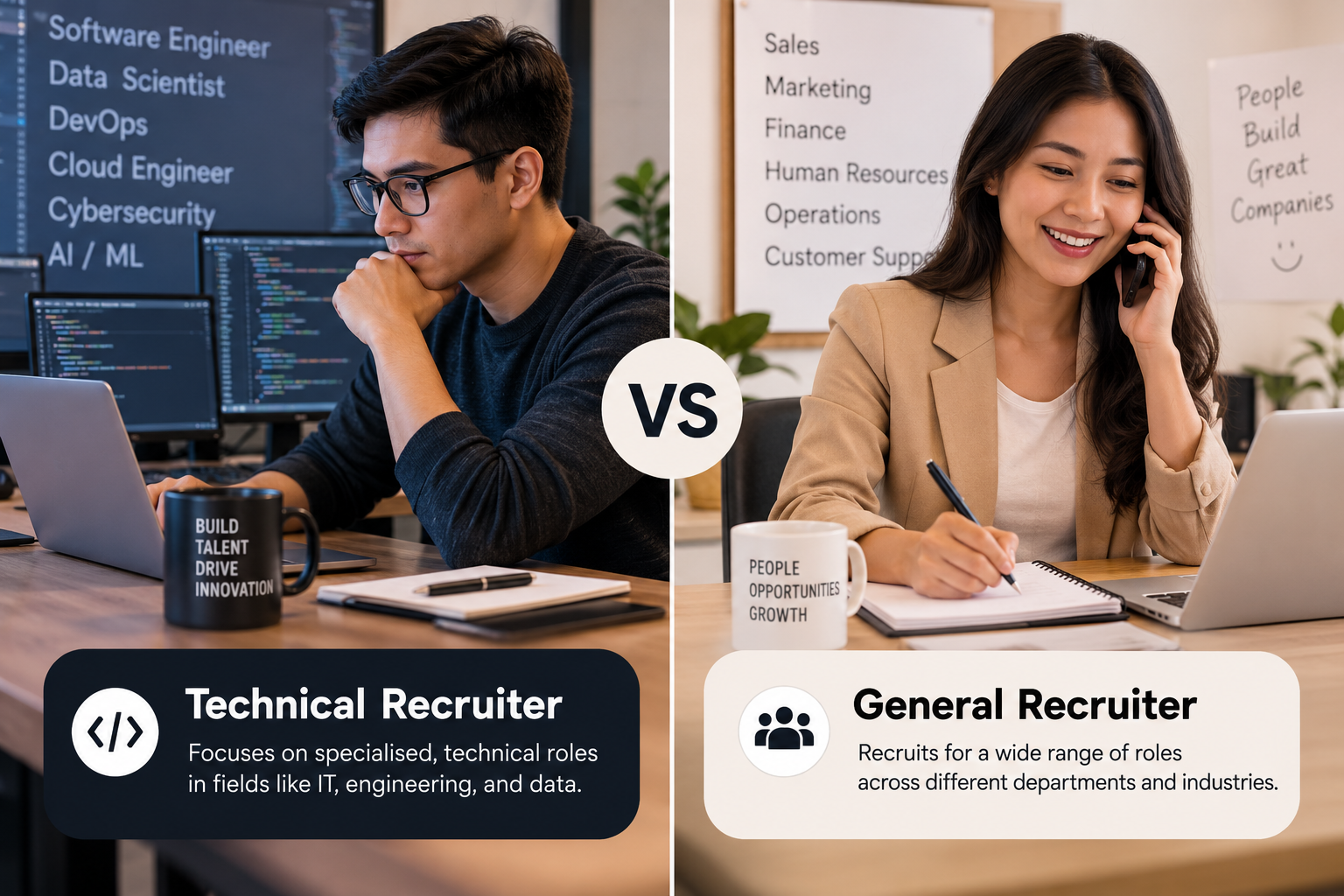
A general recruiter hires across departments and industries; a technical recruiter specializes in engineering, AI, robotics, and similarly technical roles.
Technical recruiters can evaluate hands-on skills — coding ability, hardware design, ML model development — that most HR generalists aren't equipped to assess.
Specialized roles often require sourcing passive candidates, who rarely respond to standard job postings.
Hiring for senior or executive technical roles (CTO, Head of Engineering, Chief AI Officer) carries higher stakes, making recruiter fit especially important.
Choosing the right recruiter comes down to the complexity of the role and how much technical vetting it genuinely requires.
A technical recruiter specializes in sourcing and vetting candidates for engineering, AI, and robotics roles, while a general recruiter fills a broader range of positions.
Hiring the right person for a technical role is rarely as simple as posting a job and waiting for résumés to roll in. For companies building advanced technology, the question of who does the hiring often matters as much as who gets hired. That's where the distinction between a technical recruiter and a general recruiter comes in.
Both roles exist to connect businesses with talent, but the similarities mostly end there. A general recruiter tends to work across departments and industries, filling everything from administrative roles to sales positions. A technical recruiter, on the other hand, focuses specifically on roles that require deep domain expertise, software engineers, machine learning specialists, robotics leads, and similar positions where a candidate's technical fluency has to be evaluated, not just assumed. Understanding what technical recruiting is, and how it differs from general recruiting, can save a hiring team significant time, money, and frustration.
What Is a General Recruiter?
A general recruiter, sometimes called a generalist recruiter, handles hiring across a wide range of departments and functions. One week they might be filling a customer support role, the next a marketing coordinator or office manager position.
Broad Scope, Broad Networks
General recruiters build wide talent networks rather than deep ones. They're skilled at assessing soft skills, cultural fit, and general work experience, and they typically rely on standard screening methods, resume review, phone screens, and structured interviews, that apply reasonably well across most job types.
This breadth is a strength for companies with varied hiring needs, especially smaller organizations or HR teams that need one point of contact for many different roles. The tradeoff is depth. A general recruiter usually isn't equipped to evaluate whether a candidate's claimed experience with a particular programming language, sensor architecture, or machine learning framework actually holds up.

What Is a Technical Recruiter?
A technical recruiter specializes in hiring for roles that require specific technical knowledge — software development, data science, hardware engineering, robotics, and increasingly, artificial intelligence. This is the core of technical recruiting: matching highly specialized skill sets to equally specialized job requirements.
Industry Fluency as a Baseline
What separates a technical recruiter isn't just familiarity with job titles. It's the ability to read a resume and understand what the work actually involves. A technical recruiter who's spent years in robotics hiring, for example, knows the difference between someone who "worked with" ROS (Robot Operating System) and someone who built a control stack from scratch. That fluency shapes every part of the search, from where they look for candidates to the questions they ask in a first conversation.
What Does a Technical Recruiter Do?
The day-to-day work of a technical recruiter looks different from a generalist's, even though both are ultimately trying to fill open roles.
Building Role-Specific Search Strategies
A technical recruiter typically starts by working closely with hiring managers or founders to translate a technical need into a searchable profile, not just a job title, but the actual skills, tools, and problem-solving experience the role demands. This often means going beyond a job description to understand the underlying technical challenge a company is trying to solve.
Vetting Candidates Beyond the Resume
Screening is where the difference becomes most obvious. Technical recruiters often conduct preliminary technical conversations, coordinate with subject-matter experts on the client side, or use their own domain knowledge to filter out candidates who look strong on paper but wouldn't hold up in a technical interview. This saves hiring managers from wasting time on unqualified candidates, a common frustration when general recruiters handle technical searches without the background to properly assess them.
Technical Recruiter vs. General Recruiter: Key Differences
| Factor | General Recruiter | Technical Recruiter |
|---|---|---|
| Scope | Cross-functional, broad roles | Engineering, AI, robotics, and similarly specialized roles |
| Screening depth | Soft skills, general experience | Technical skills, domain-specific problem solving |
| Candidate pool | Wide, general talent networks | Niche networks, often passive candidates |
| Time-to-fill for specialized roles | Often longer, more misfires | Typically faster, higher match quality |
| Industry vocabulary | General HR language | Fluent in the technical domain itself |
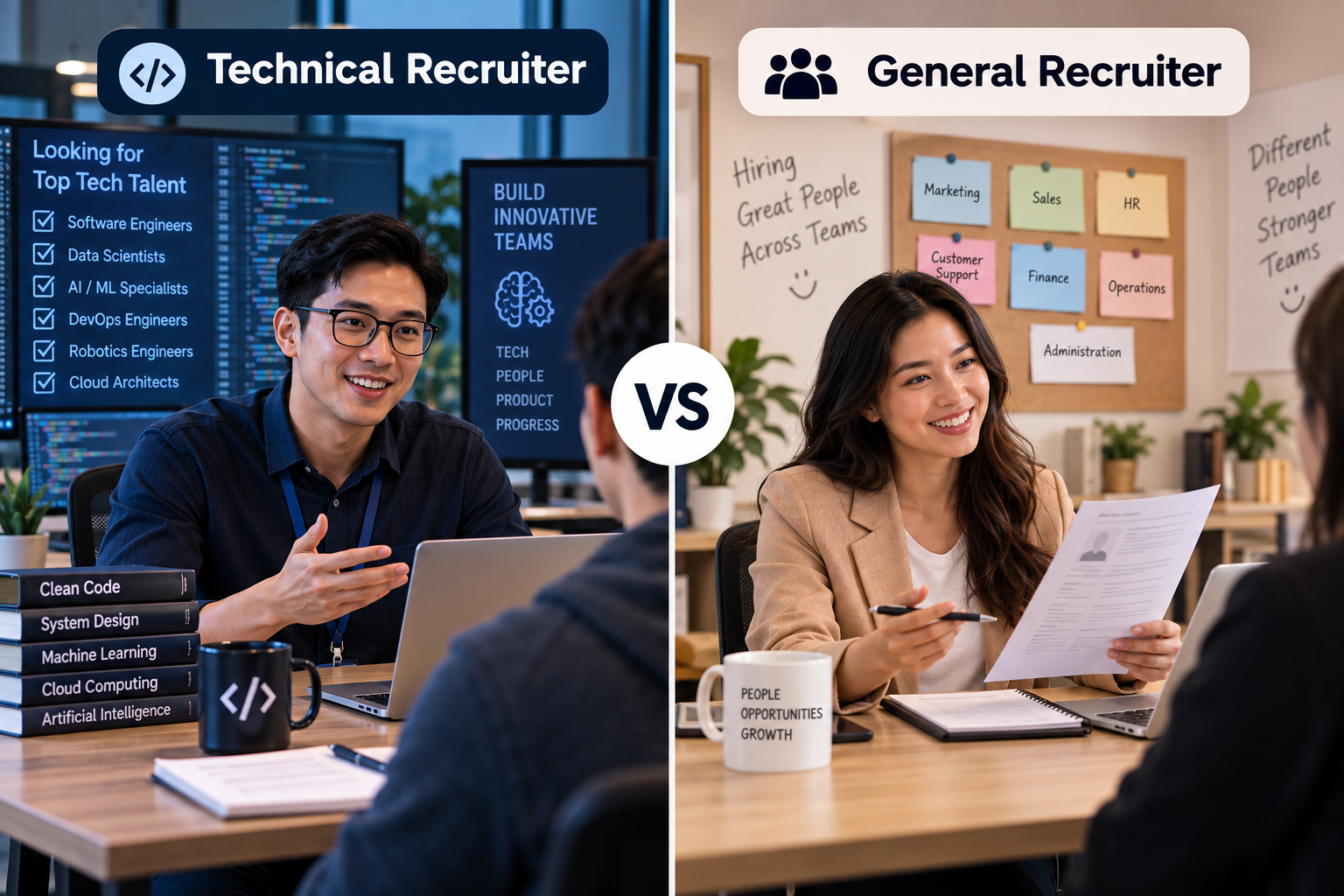
The differences aren't about which recruiter is "better", they're about fit. A general recruiter can fill a technical role, but it usually takes longer and carries more risk of a mismatch. A technical recruiter can, in theory, fill a general role, but that would be an inefficient use of their specialized expertise.
How Technical Recruiters Source and Screen Specialized Candidates
Sourcing From Passive Talent Pools
Highly skilled technical candidates, particularly at senior or leadership levels, are rarely actively job hunting. Technical recruiters spend a lot of their time engaging passive candidates: people who are currently employed, not browsing job boards, and only open to a move if the opportunity genuinely fits their expertise and career trajectory. This requires relationship-based sourcing built over years, not a single job posting.
Technical Screening in Practice
Once a candidate is identified, screening goes deeper than a standard interview. A technical recruiter might ask candidates to walk through a specific project, discuss tradeoffs they made in a past technical decision, or explain a concept in a way that reveals real understanding versus surface-level familiarity. Some technical recruiters also loop in outside technical advisors for an added layer of verification before a candidate reaches the client.
When Should You Hire a Technical Recruiter Instead of a General Recruiter?
Not every open role needs a specialist. But certain signals suggest it's time to bring one in.
Signs You Need Specialized Support
The role requires evaluating hands-on technical skill (coding ability, hardware design, ML model development) that an HR generalist can't assess.
Previous searches through general channels have produced candidates who don't meet the technical bar.
You're hiring for a senior or executive technical role — a Head of Engineering, CTO, or Chief AI Officer — where a poor match is costly.
The talent pool for the role is small, and most qualified candidates aren't actively searching.
If any of these apply, a technical recruiter's domain expertise typically pays for itself in reduced time-to-hire and stronger long-term retention.
How to Choose the Right Recruiter for Your Hiring Needs
Choosing between a generalist and a specialist comes down to the complexity of the role and how much technical vetting it genuinely requires.
Questions to Ask Before You Commit
Before engaging a recruiting partner, it helps to ask a few direct questions: Have they placed candidates in this exact technical field before? Can they speak knowledgeably about the tools and challenges specific to your industry? Do they have an existing network of passive candidates in this space, or would they be starting from scratch? A recruiter who can answer these clearly is far more likely to deliver qualified candidates efficiently.
Why Specialized Technical Recruiting Matters for Advanced Technology Hiring
The gap between a technical recruiter and a general recruiter becomes most apparent at the highest stakes: hiring for robotics, AI, and hard-tech leadership roles. A mis-hire at the senior leadership or C-suite level doesn't just cost time, it can set a technical roadmap back months and shake confidence with investors or partners.
This is precisely the space Samson Rose works in. As a retained search firm focused on robotics, artificial intelligence, and advanced technology companies, Samson Rose partners with businesses to fill senior leadership roles, director-level positions, C-suite executives such as CTOs and Chief AI Officers, and technical specialists who are difficult to source through general channels. From initial consultation through final placement, the process is built around the kind of technical fluency and passive-candidate access that general recruiting simply isn't designed to provide. Companies building complex technology deserve a hiring partner who understands that technology. Contact Samson Rose to talk through your next technical or executive search.

Frequently Asked Questions
-
Yes. Technical recruiters specialize in exactly this kind of search, using domain-specific sourcing methods and screening processes designed to identify candidates who meet a narrow, specialized skill set.
-
Be specific about the technical requirements, the problems the role needs to solve, team structure, and any non-negotiable qualifications. The more context a recruiter has, the more precisely they can target candidates.
-
Ask about past placements in your specific field, request examples of similar searches, and pay attention to whether they can speak fluently about the technical challenges your industry faces.
-
Yes, especially a technical recruiter. Their access to passive candidate networks often surfaces qualified people who aren't visible through standard job postings.
-
Expect regular communication, a clear search strategy, pre-vetted candidates rather than a high volume of unqualified resumes, and support through offer negotiation and onboarding.