
Key Takeaways
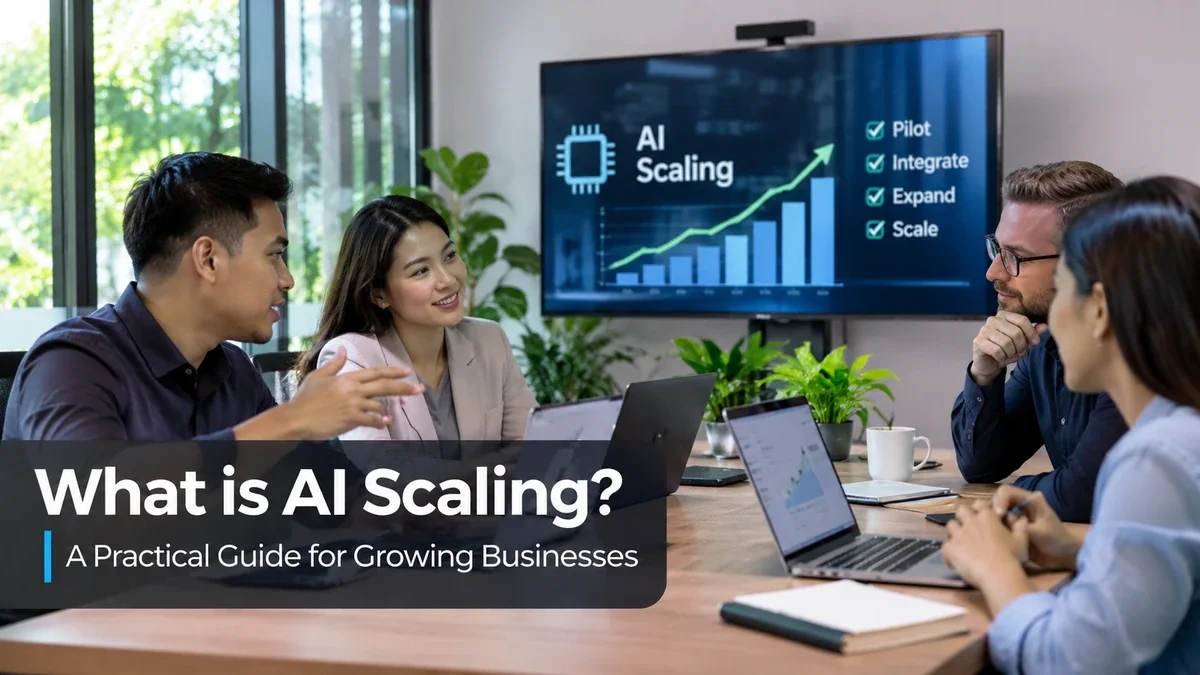
AI scaling goes beyond adoption: It involves expanding successful AI applications across business teams, workflows, and operations while maintaining reliability and performance.
Start with clear business goals: Identify specific problems AI can solve, such as repetitive tasks, operational inefficiencies, or customer service challenges.
Build the right foundations: Reliable data, suitable infrastructure, skilled employees, and leadership support are essential for successful AI scaling.
Expand AI gradually: Test solutions through controlled pilot projects, evaluate their results, and scale applications that demonstrate measurable value.
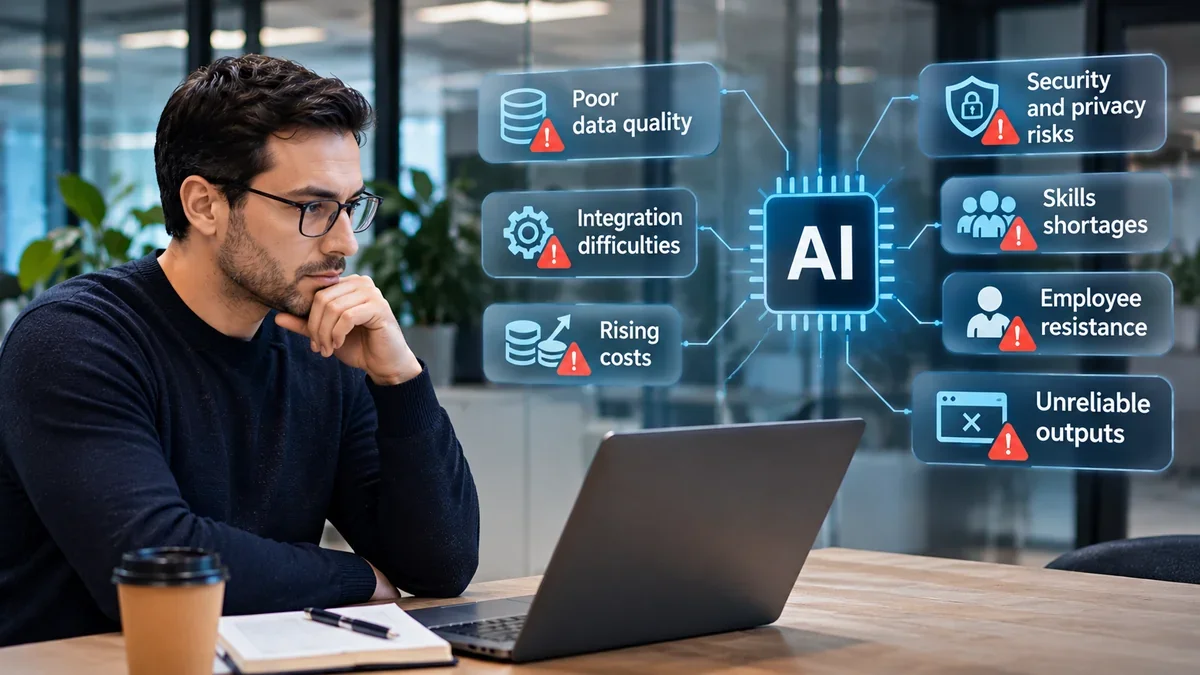
Prepare for implementation challenges: Data quality, integration difficulties, rising costs, security risks, and talent shortages can affect AI adoption.
Measure business outcomes: Track productivity, operating costs, accuracy, customer experience, employee adoption, and return on investment.
Invest in specialised talent: Businesses may need experienced AI professionals, technical specialists, and technology leaders to support long-term AI growth.
AI scaling is the process of expanding artificial intelligence from small pilot projects into reliable, secure systems used across business teams, workflows, and operations.
Artificial intelligence is becoming an increasingly important part of how businesses operate, from automating repetitive tasks to improving customer experiences and supporting complex decisions. However, introducing an AI tool is only the beginning. The real challenge is making it work reliably across an organisation as its needs, operations, and customer base grow. Businesses exploring AI talent may also need to consider the people required to support this growth.
This is where AI scaling becomes important. Businesses need more than access to AI technology. They need the right infrastructure, people, processes, and strategy to turn individual AI applications into long-term business capabilities. For organisations developing AI teams, having the right technical expertise is an important part of that process.
Understanding what AI scaling involves can help business leaders make better technology investments, avoid common implementation problems, and identify opportunities to improve efficiency without creating unnecessary complexity.
What Is AI Scaling and What Does It Mean for Businesses?
AI scaling refers to expanding the use of artificial intelligence across a business while maintaining its performance, reliability, security, and value. It involves moving beyond isolated experiments and integrating successful AI applications into everyday operations.
For example, a company might initially use an AI assistant to help one customer service representative answer routine enquiries. As the solution proves useful, the business could expand it across the entire support team, connect it to its customer management system, and introduce automated workflows.
This is different from simply adopting an AI tool. Adoption means introducing technology into a business, while scaling involves making that technology work consistently across more users, departments, and processes.
It is also worth distinguishing business AI scaling from AI model scaling. The latter generally concerns increasing model size, training data, computing resources, or inference-time computation to improve model capabilities. Both concepts are important, but this article focuses on scaling AI within business operations. Organisations developing advanced AI models may require different technical expertise from those primarily expanding existing AI applications.

Why Is AI Scaling Important for Growing Businesses?
As companies expand, manual processes and disconnected systems can become increasingly difficult to manage. AI scaling helps businesses extend automation and intelligent decision-making without relying entirely on additional manual work.
Improving operational efficiency
AI can automate repetitive activities such as processing documents, categorising enquiries, summarising information, and handling routine administrative tasks. Scaling successful applications across departments can help employees spend more time on responsibilities that require judgement and specialist knowledge.
Supporting better decisions
AI systems can analyse large amounts of information, identify patterns, and help teams access relevant insights. When properly implemented, these capabilities can support planning, forecasting, and operational decisions. Business leaders can also benefit from asking the right technology questions when evaluating new AI initiatives.
Improving customer experiences
Businesses can use AI-powered assistants, recommendation systems, and automated support tools to respond more efficiently to customer needs. However, human assistance should remain available when enquiries require expertise, sensitivity, or individual judgement.
Supporting sustainable growth
A scalable AI solution can support increasing workloads without requiring businesses to redesign every process as they grow. The goal is not to automate everything, but to build capabilities that remain useful as business requirements change. This is particularly relevant to companies investing in business automation.
What Does a Business Need Before Scaling AI?
Before expanding AI across an organisation, businesses should assess whether their existing systems, people, and processes can support wider implementation.
Reliable and accessible data
AI applications depend on the information they receive. Incomplete, outdated, inconsistent, or poorly organised data can produce unreliable results. Businesses should review data quality, accessibility, ownership, and privacy before connecting AI tools to important information sources.
Suitable infrastructure and technology
Existing software, databases, cloud services, and computing resources must support the intended AI applications. Businesses should also consider system compatibility, integration requirements, performance, and future operating costs. In sectors such as manufacturing, this can include specialised technical talent capable of working with complex technology environments.
Clear business objectives
AI projects should address identifiable business problems. Whether the goal is reducing processing time, improving customer support, or increasing operational accuracy, organisations need measurable objectives before expanding a solution.
Skilled employees and leadership support
Successful implementation requires people who can select, manage, monitor, and use AI responsibly. Employees also need appropriate training, while leadership must establish ownership and support organisational changes. Businesses building these capabilities may need to recruit AI leaders who can connect technical decisions with wider business goals.

How to Scale AI in a Business: A Practical Step-by-Step Approach
Scaling AI is easier to manage when businesses approach implementation gradually rather than attempting to transform every department simultaneously.
1. Identify a business problem
Start by identifying a process where AI could provide measurable value. Look for repetitive tasks, operational bottlenecks, or activities that require significant time to complete.
2. Choose a suitable AI application
Evaluate available tools and technologies against the business requirement. Consider functionality, accuracy, integration options, security, and total cost rather than choosing a solution simply because it is popular. Companies exploring AI implementation should consider how the proposed solution addresses an actual operational need.
For a practical example of how businesses can move beyond AI experimentation, listen to Machine Minds Episode 99: Unlock Human + Machine Potential | Zac Engler. In this episode, Zac Engler, founder and CEO of Bodhi AI, discusses practical AI implementation, custom AI workflows, and how businesses can turn generative AI into measurable business value.
3. Run a controlled pilot project
Test the solution within a limited environment. For example, a business could introduce an AI-powered document processing tool to one administrative team before expanding it across the organisation.
Establish baseline measurements so the results can be compared with existing processes.
4. Evaluate performance and prepare infrastructure
Review the pilot's accuracy, reliability, user feedback, and business impact. Resolve data quality and integration problems before increasing usage. A successful demonstration does not automatically mean a solution is ready for wider deployment. Businesses working with complex robotics systems may also need to consider how AI applications interact with physical equipment and operational environments.
5. Establish governance and employee training
Define who can access the system, what information it can process, and when human approval is required. Provide employees with practical guidance on using AI tools and recognising inaccurate outputs.
6. Expand gradually and monitor results
Introduce the solution to additional teams or workflows in manageable stages. Continue monitoring performance, costs, security, and employee adoption. Adjust the implementation as business requirements evolve. Companies developing AI capabilities should also plan for the expertise needed to maintain and improve their systems.
What Are the Biggest Challenges of Scaling AI?
Although AI offers significant opportunities, expanding its use introduces technical, financial, and organisational challenges.
Poor data quality: Inaccurate or fragmented information can undermine AI performance.
Integration difficulties: Connecting AI applications with older software and existing workflows may require specialist development. This can involve software engineering expertise.
Rising costs: Software subscriptions, computing resources, data storage, integration, and maintenance can increase as usage expands.
Security and privacy risks: Businesses must protect sensitive information and understand how third-party providers process and retain data.
Skills shortages: Organisations may struggle to find employees with the technical expertise needed to implement and manage AI systems. Recruiting machine learning engineers can be particularly challenging when specialised experience is required.
Employee resistance: Unclear expectations and insufficient training can make adoption difficult.
Unreliable outputs: AI systems can produce incorrect or misleading information, making appropriate testing, monitoring, and human oversight essential.
Businesses should address these challenges before expanding AI into critical operations. Scaling a poorly performing solution can increase costs and risks rather than deliver meaningful improvements. In advanced applications, computer vision engineers may be needed to address specialised development and performance requirements.
How Do You Measure the Success of AI Scaling?
AI scaling should be evaluated through measurable business outcomes, not simply the number of tools deployed or employees using them.
Useful performance indicators include:
Productivity: How much time does AI save on specific tasks?
Operating costs: Has the solution reduced the cost of completing a process?
Accuracy: Are AI-generated results meeting the required quality standards?
Customer experience: Have response times, satisfaction, or service consistency improved?
Employee adoption: Are teams using the solution effectively?
Return on investment: Do the financial and operational benefits justify implementation and ongoing costs?
Businesses should establish baseline measurements before deployment and compare results over time. They should also monitor unintended consequences, such as increased manual correction or additional support requirements.
A solution that performs well technically may still fail commercially if its unit economics are unsustainable or it cannot improve real-world operational performance. This is particularly important in robotics and advanced automation, where technical accuracy must translate into measurable business value. For example, Raise Robotics demonstrates how high-precision autonomous systems can help reduce construction layout costs and prevent expensive rework. To learn more, listen to Machine Minds Episode 112: Reinventing Construction with Autonomous Precision | Rishabh Aggarwal, where Raise Robotics CTO Rishabh Aggarwal discusses the engineering challenges and practical realities of deploying autonomous robotics in construction.
When Should a Business Work with an AI Implementation Partner?
Some organisations have the internal expertise to manage AI adoption independently. Others may need external support, particularly when implementation involves complex integrations, specialised infrastructure, data management, or advanced technical requirements.
An AI implementation partner can help assess business needs, identify suitable applications, plan deployment, and address technical challenges. Businesses should look for providers with relevant experience, a clear implementation process, and an understanding of their industry and operational requirements. Knowing how to choose a recruitment partner can also help organisations find the specialist talent needed to support their technology initiatives.
However, technical implementation is only one part of successful AI scaling. Organisations also need the right people to lead projects, develop systems, manage teams, and ensure AI initiatives support wider business objectives.
Ready to Scale AI and Unlock Your Business’s Growth Potential?
AI scaling is not simply about introducing more artificial intelligence tools. It is about building the technical capabilities, processes, and teams needed to use AI reliably as a business grows. The right strategy can help organisations move beyond experimentation and turn successful applications into sustainable business capabilities.
Having the right talent is an important part of that journey. Samson Rose is a specialised recruiting company supporting businesses in robotics, artificial intelligence, and advanced technology. From senior leaders, department heads, directors, and C-suite executives such as CTOs and Chief AI Officers to highly specialised technical professionals, Samson Rose helps businesses find the people they need to advance their technology initiatives.
From the initial consultation through to final placement, Samson Rose works with businesses to identify and recruit high-level talent for demanding technical roles. This includes robotics engineers and executives with experience in AI leadership.
If your organisation is building its AI capabilities or preparing to scale its operations, contact Samson Rose to discuss your recruitment needs.
Frequently Asked Questions
-
Small businesses can scale AI by starting with affordable tools and specific, high-value tasks. Cloud-based services and existing AI platforms can reduce the need for expensive infrastructure. The best approach is to expand gradually according to available resources and business priorities.
-
There is no universal timeline. A straightforward application may be deployed relatively quickly, while organisation-wide implementation can take considerably longer. Data readiness, integrations, security requirements, employee training, and system complexity all influence the process.
-
No. Businesses can use existing AI platforms, third-party models, or application programming interfaces (APIs). Customising an existing model or developing one from scratch may be appropriate when specific requirements justify the additional investment and technical work.
-
Yes, many AI solutions can integrate with existing business applications through APIs, connectors, and automation platforms. However, compatibility, data access, security, and system limitations should be assessed before implementation.
-
Ownership and usage rights depend on the provider's terms, service agreement, and applicable laws. Businesses should review data retention policies, training permissions, privacy terms, and contractual protections before sharing confidential or sensitive information.